
Let’s Talk About Civil Rights Letters
Those letters of historical note were absolutely full of surprises. Some were sweet, like the young girl writing to President Obama, thanking him for his views. Some taught me things I never would have realized, like that Abraham Lincoln didn’t have a beard at first. Some revealed a darker, insidious side of history through testimonies of the racism and sexism of the times. I noticed that I was most commonly surprised by the Civil Rights Movement. And I don’t think I was the only one. In our 3-2-1 analysis presentations, I heard a few people say, “I had no idea about this,” and “I didn’t know about that” on the contents of letters from the Civil Rights movement. Our history classes never taught us this side of history. Sure, they taught us about civil rights groups like the NAACP, events, rallies, and breakthroughs that led to the Civil Rights Act getting passed. They told us about some civil rights heroes like MLK, Malcolm X, and Rosa Parks. Yet they failed to cover the full story. People today have begun to question the information fed to us, especially within the American education system. What side of the story are they leaving out? Did they hide this information for a reason? I wanted to check out these Civil Rights movement letters for myself because I, too, hold some skepticism about the US government and its shady coverups. It’s better to draw my own conclusions from all the information than just believe spoon-fed ideas.
Starting off, we have Malcolm X’s letter to Martin Luther King Jr. I’d say it’s the least surprising of the letters but still worthy of note. History books love to note how Martin Luther King Jr.’s views and Malcolm X’s were polar opposites. Martin Luther King Jr., as we all likely know, called for desegregation and supported nonviolent protest. Malcolm X supported the Nation of Islam’s beliefs in Black Nationalism–that White people are inferior–and, thus, wanted to uphold the separation of races. He also disliked the nonviolent tactics used by Civil Rights activists–such as MLK–believing that African Americans deserved to defend themselves. What is less known is how, as time progressed, Martin Luther King Jr.’s and Malcolm X’s views grew similar. To be more specific, Malcolm X became disillusioned by the Nation of Islam’s beliefs, slowly becoming more accepting of the Civil Rights movement and questioning his views on the separation of races and Black Nationalism. Malcolm X’s views may not have changed entirely in 1963 when he sent this letter to Martin Luther King Jr., but there is no doubt he had begun to question them. This letter demonstrates a turning point in Malcolm X’s philosophy and testifies to his growing openness to opposing views. His request to unite to defeat a common enemy and prevent “a racial explosion” starkly contrasts with his criticisms of MLK from years prior. It’s hard not to fall into the trap and claim that the “‘minor’ differences” between their views are an understatement. Even MLK believed that self-defense was acceptable in dire situations. There’s less difference between these two activists than our teachings make it out to be.
Next on our list is Jackie Robinson’s letters to two different presidents. What do we most likely know about him that differs from how these letters portray him? As our classmates said, we know Jackie Robinson as the first African American baseball player, a breaker of racial barriers. Yet, the side of Jackie Robinson shown in these letters advocates for civil rights beyond baseball and is a successful businessman. The fact he was Vice President of Personnel at Chock Full o’Nuts shocked me more than anything. My parents buy that brand of coffee all the time. Not once did I ever associate that coffee with Jackie Robinson. Robinson’s earlier letter to President Eisenhower reprimands him for saying, “We must have patience.” He criticizes politely with no hint of hostility, yet it is criticism nonetheless. After all, Eisenhower’s stalling seems to pander to pro-segregationists, which isn’t a good look for him. Robinson’s letter to President Kennedy is more of a reminder. He warns that if Kennedy attempts to obstruct the Civil Rights, he will not hesitate to criticize him. It’s a harsh reminder that brings the president’s character into question. What has Kennedy done that made Robinson think he’d stall like Eisenhower?
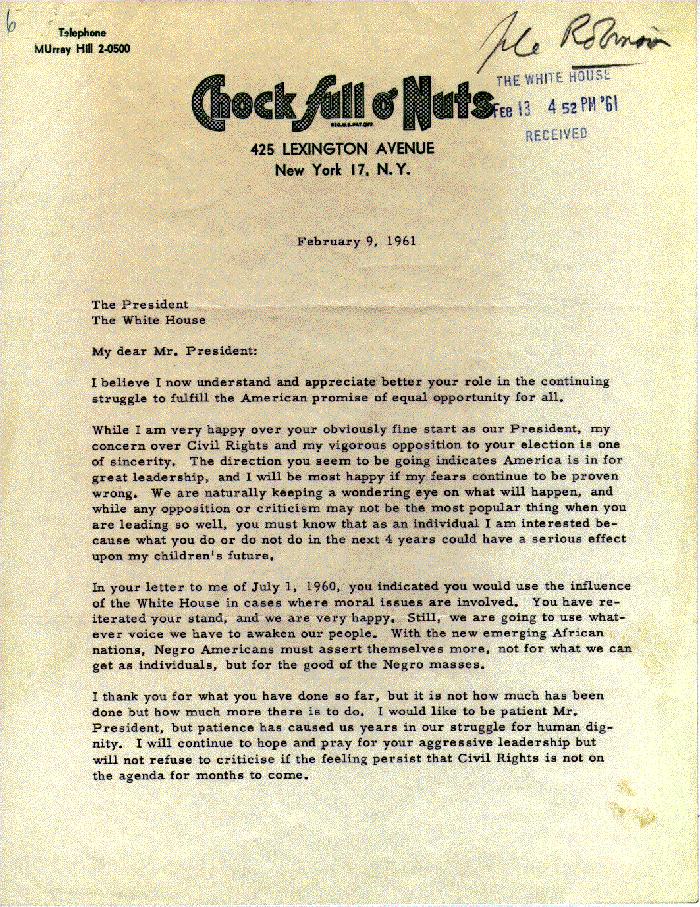
In essence, teachings today often market Jackie Robinson as a sporty inspirational figure to interest young boys in the history of Civil Rights. This “Robinson the baseball player” focus downplays his activist and entrepreneur side. Based on the content of these letters, I’d say his activist side is vaguer on purpose, attempting to hide his critical view of the government.
And now for the darkest letter on this list, the MLK letter from the FBI. Whether or not this letter was absent from the history books for a reason is no question. This letter is despicable; its word choice and accusations make me sick to my stomach. It immediately starts by disregarding any title and likening his last name to “King Henry the VIII,” setting the disrespectful and condescending tone. The letter repeatedly describes him as a beast and an animal, dehumanizing him for his actions. The phrase “you are done” is repeated five separate times to drive home a sense of hopelessness. The letter even uses his faith as a weapon, creating an overly harsh judgment of his sins. It’s disgusting. Worst of all, the purpose of this letter was to drive MLK to suicide. Investigations proved that the FBI was behind this disgraceful letter, which is a horrible look for the organization and the US government as a whole. The government doesn’t want young, impressionable American citizens to see them as villains, so they purposefully excluded that letter from educational material. However, it’s crucial to consider this letter because it holds proof of the government’s mistakes and shady practices, allowing us to take a step back and avoid the blind trust of the authorities.
I think this gracefully encapsulates what I’ve found here. Take things with a grain of salt. Things said to us by credible people might not be the truth. Sometimes, they don’t even outright lie to us; they just hide it in plain sight—which could be a lie within itself. There’s always more to the picture hidden behind the frame, like how these letters brought more context to the Civil Rights movement. We must seek out the truth ourselves, which usually isn’t hard. But how often do we go out of our way and double-check the facts?